 MuhammadSalis
Scientists confirm a massive asteroid impact in southern China’s Guangdong province created the Jinlin crater 10,000 years ago, unleashing energy equal to 40 Hiroshima-sized atomic bombs.
Discovery of a Rare Ancient Crater
GUANGDONG, China, Oct 27, 2025: Researchers have confirmed the discovery of a massive asteroid impact crater in southern China’s Guangdong province, revealing that an extraterrestrial object struck Earth about 10,000 years ago with the explosive power of 40 atomic bombs.
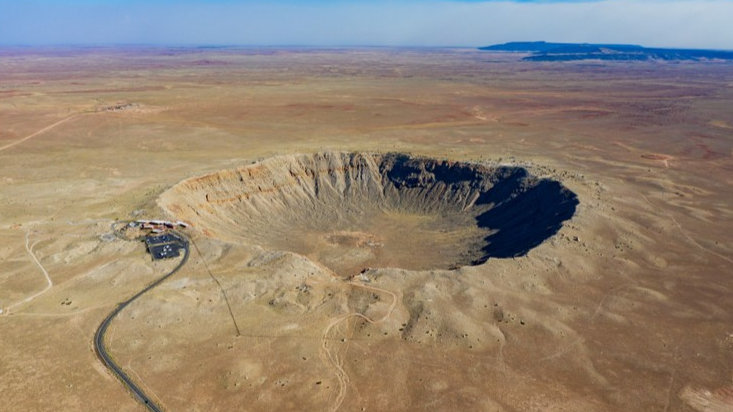
The site, known as the Jinlin crater, is located near Zhaoqing city and measures roughly 2,950 feet (900 metres) across, making it the fifth confirmed meteorite impact site in China — and the first ever discovered in the southern region.
The research, published in the journal Matter and Radiation at Extremes on October 15, attributes the crater’s formation to a hypervelocity bolide impact, an event where an asteroid collides with the planet’s surface at speeds exceeding 20 kilometres per second.
Power of the Explosion
According to Chen Ming, a researcher at the Centre for High Pressure Science and Technology, the impact released energy equivalent to 600,000 tons of TNT, or about the force of 40 Hiroshima-sized nuclear explosions.
“The impact dissipated energy on a scale rarely seen in human history,” said Chen. “It would have caused immense shock waves, surface deformation, and environmental changes across the surrounding landscape.”
The asteroid responsible for this crater is estimated to have been around 100 feet in diameter, entering the atmosphere at high velocity before striking the Earth and vaporising on impact.
Evidence Hidden in the Rocks
To confirm the extraterrestrial origin of the Jinlin crater, scientists examined quartz samples taken from the site. They found planar deformation features (PDFs) — microscopic lines of damage that form when crystals are exposed to extremely high pressure and temperature.
Such deformation features are a hallmark of meteorite impacts and cannot be produced by volcanic or tectonic activity.
“The microscopic deformation in quartz provides irrefutable evidence that the Jinlin crater was formed by an asteroid impact,” the researchers wrote.
This finding rules out alternative theories such as volcanic eruptions or sinkhole formation, confirming that the crater’s unique geology is the result of a catastrophic extraterrestrial event.
Why the Crater Survived
Most asteroid craters on Earth are erased over time due to erosion, tectonic activity, and vegetation, especially in humid regions like southern China, which receives more than 59 inches of rainfall annually.
That the Jinlin crater remained visible makes its preservation remarkable. Scientists believe that its location in a relatively stable geological zone helped protect its shape, even though erosion continues to expose and reshape its outer rim.
Significance of the Discovery
The Jinlin crater offers valuable insights into both China’s geological history and Earth’s impact record. Globally, scientists have identified about 200 confirmed impact sites, but many more are believed to be buried or eroded beyond recognition.
This discovery highlights how hidden impact structures can be detected using modern geophysical methods and microscopic analysis.
“The Jinlin crater opens new avenues for discovering more impact sites across Asia,” the research team noted. “It serves as a crucial reference point for identifying other buried craters through erosion and rock deformation studies.”
Next Steps in Research
Scientists plan to conduct carbon dating and isotopic analysis to pinpoint the precise age of the Jinlin impact and understand its effects on the local climate, ecosystems, and topography.
Preliminary assessments suggest the event may have caused regional temperature shifts, vegetation loss, and atmospheric disturbances.
The discovery also underscores the importance of planetary defence research, as even a 100-foot-wide asteroid — similar to the one that formed Jinlin — could cause devastating destruction if it struck a populated area today.
Summary
- Location: Near Zhaoqing, Guangdong Province, China
- Crater size: ~2,950 feet wide
- Asteroid size: ~100 feet in diameter
- Impact energy: ~600,000 tons of TNT (40 Hiroshima bombs)
- Estimated age: ~10,000 years
- Publication: Matter and Radiation at Extremes (October 2025)
- Significance: Fifth confirmed crater in China; first in the southern region
The Jinlin crater discovery adds a dramatic new chapter to Earth’s impact history — a reminder of how celestial events can leave permanent marks on our planet’s surface and shape its geological destiny.


1 thought on “Asteroid Impact in China 10,000 Years Ago Released Energy Equal to 40 Atomic Bombs”