MuhammadSalis
BM lays out a rigorous, end-to-end architecture for fault-tolerant quantum computing, targeting a 200-logical-qubit, 100-million-gate system (“IBM Quantum Starling”) by 2029. Here’s what that means, how it works, and why the roadmap matters.
Overview — From promise to plan
IBM has published a detailed technical framework and an updated multi-year roadmap that, together, make a bold claim: by 2029, the company plans to deliver IBM Quantum Starling, a large-scale, fault-tolerant quantum computer capable of executing ~100 million quantum gates across ~200 logical qubits. The system is slated for IBM’s historic Poughkeepsie, New York facility, long a home to first-of-its-kind computing milestones.
Two new research papers accompany the roadmap update:
- A modular, end-to-end architecture for building a scalable, fault-tolerant quantum computer, centered on bivariate bicycle (BB) codes—a family of quantum LDPC (qLDPC) codes introduced by IBM research and designed to slash qubit overhead while preserving strong error protection.
- A real-time, hardware-amenable decoder (accurate, fast, compact, flexible) that can run on FPGAs or ASICs, removing a critical bottleneck for live error correction during computation.
IBM positions this as the most viable path to fault tolerance within the decade, and it ties the long-term Starling vision to near-term milestones on hardware, software, and systems integration—each intended to unlock bigger, deeper circuits on the way to demonstrable quantum advantage.
Why fault tolerance is the threshold that matters
Today’s quantum processors can run useful experiments—IBM cites accurate execution for circuits with 5,000+ two-qubit gates—but error rates and noise limit circuit depth and algorithmic scale. Techniques like error mitigation help, yet they do not replace true error correction.
Fault tolerance changes the game. Instead of manipulating fragile physical qubits directly, computation happens on logical qubits—quantum information encoded across many physical qubits and continuously protected by an error-correcting code. If implemented efficiently, logical errors become exponentially rarer as code distance scales, enabling deep circuits (hundreds of millions of gates) and long programs that remain reliable from start to finish.
IBM’s architecture sets six design criteria any serious fault-tolerant system must meet:
- Fault-tolerant: Logical error rates suppressed enough that real algorithms succeed.
- Addressable: Prepare/measure individual logical qubits anywhere in a computation.
- Universal: Support a universal instruction set at the logical level.
- Adaptive: Real-time measurement and decoding that can change subsequent instructions.
- Modular: Replaceable, quantum-connected modules to scale the hardware.
- Efficient: Achieve the above with reasonable physical resources.
The code at the core — bivariate bicycle (BB) qLDPC
At the heart of IBM’s stack is a family of qLDPC codes—notably the bivariate bicycle (BB) codes—engineered to deliver surface-code-like protection with ~10× fewer physical qubits per logical qubit at comparable distances.
- The “gross” code: A [[144, 12, 12]] gross code encodes 12 logical qubits into 144 data qubits (plus 144 syndrome qubits), for a total of 288 physical qubits.
- Two-gross variant: A larger [[288, 12, 18]] version boosts distance for stronger error suppression.
These codes demand non-local connectivity on chip to realize their sparse parity checks efficiently. IBM’s roadmap therefore emphasizes new coupler technologies to bring distant qubits into play without unwieldy routing.
Compute where it counts — LPUs, lattice surgery & adapters
A code is only half the story; you need a way to compute on logical qubits with minimal overhead.
- LPUs (Logical Processing Units): IBM and collaborators show how to build efficient LPUs for qLDPC codes using generalized lattice surgery. LPUs enable logical stabilizer operations (Cliffords), state prep, and measurements with low-weight checks and few extra qubits.
- Universal adapters: To scale beyond a single module, IBM proposes adapters—bridging constructs that move/logically connect information between modules. These leverage demonstrated inter-module microwave “ℓ-couplers” (and on-chip c-couplers) to realize the long-range interactions the code and modular design require.
Together, memory + LPU + adapters form modular building blocks that can be tiled and networked to reach practical scales.
Making universality practical — magic state factories
Clifford gates alone aren’t universal. To reach full universality, IBM integrates magic state factories, which:
- Prepare and distill special non-Clifford resource states (e.g., for T gates).
- Inject those states into logical circuits to implement the missing gate(s).
IBM reports prior experimental demos of magic-state protocols and, in the new architecture, provides explicit fault-tolerant instruction sets and a compilation strategy tailored to the bicycle architecture’s constraints. The design aims to keep distillation overheads low enough to run long, useful programs at scale.
The decoder piece — real-time, hardware-class decoding
No fault-tolerant system works without a fast, accurate decoder that:
- Ingests syndrome data (error signals),
- Infers the most likely error pattern,
- And updates the computation in real time.
IBM introduces a decoder architecture (dubbed Relay-BP) that is accurate, fast, flexible, and compact enough to fit on FPGAs or ASICs—crucial for low-latency feedback during adaptive circuits. IBM reports 5×–10× reductions over leading decoders, helping ensure decoding won’t require giant HPC clusters just to keep pace.
Hardware on-ramps — the roadmap, year by year
IBM’s plan isn’t a single leap; it’s a sequence of shippable systems that each introduce enabling technologies. Highlights:
- 2025 — IBM Quantum Loon:
A chip architecture with higher on-chip connectivity (e.g., c-couplers) designed to support high-rate qLDPC experiments and the long-range interactions BB codes prefer. - 2026 — IBM Quantum Kookaburra:
First processor module able to store quantum info in a qLDPC memory and process it with an attached LPU—a major step from memory to logic. - 2027 — IBM Quantum Cockatoo:
Demonstrates entanglement between modules via universal adapters, laying the groundwork for multi-module computation. - 2028 — Starling proof-of-concept:
Validates magic state injection across multiple modules; integrates the relay-class decoder. - 2029 — IBM Quantum Starling:
Target system: ~200 logical qubits, ~100 million logical gates, running in Poughkeepsie as IBM’s first large-scale, fault-tolerant quantum computer.
Near-term compute — the Nighthawk line & deeper circuits
While the fault-tolerant stack matures, IBM is also pushing pre-FTQC devices to higher utility:
- IBM Quantum Nighthawk (2025 launch):
A 120-qubit square lattice architecture (more nearest-neighbor connectivity than the heavy-hex Heron generation). Although Nighthawk initially targets ~5,000 gates per circuit like Heron, the square lattice’s connectivity unlocks ~16× deeper effective circuits through improved routing and compilation. - Scaling to 2028:
IBM projects Nighthawk-class systems reaching ~15,000 gates and linking up to 9 modules via ℓ-couplers for ~1,080 connected qubits, supporting larger, more complex experiments on the path to advantage.
On the software side, IBM is upgrading Qiskit Runtime for scalable dynamic circuits, adding better error mitigation, utility mapping for advantage discovery, and a C API for cleaner integration with HPC workflows. The message: start building advantage-scale applications now, so they can migrate seamlessly to fault-tolerant hardware later.
How the pieces fit — the full stack at work
- Physical layer: Superconducting qubits with enhanced on-chip connectivity (square lattice, c-couplers) and inter-module ℓ-couplers.
- Code layer: BB qLDPC codes (gross and two-gross variants) for efficient logical encoding at lower overhead.
- Logic layer: LPUs using generalized lattice surgery to execute fast, low-overhead Clifford operations; adapters to shuttle logical info across modules.
- Universality layer: Magic state factories enabling non-Clifford gates; a compilation flow optimized for the bicycle architecture.
- Feedback layer: Relay-BP-class decoders on FPGAs/ASICs for real-time, low-latency syndrome processing.
- System layer: Modular scaling to hundreds of logical qubits and hundreds of millions of gates, integrated in Poughkeepsie for production-grade operation.
- Software layer: Qiskit Runtime, dynamic circuits, mitigation tools, and hybrid quantum-HPC orchestration to translate user programs into performant runs.
Poughkeepsie — where computing firsts happen
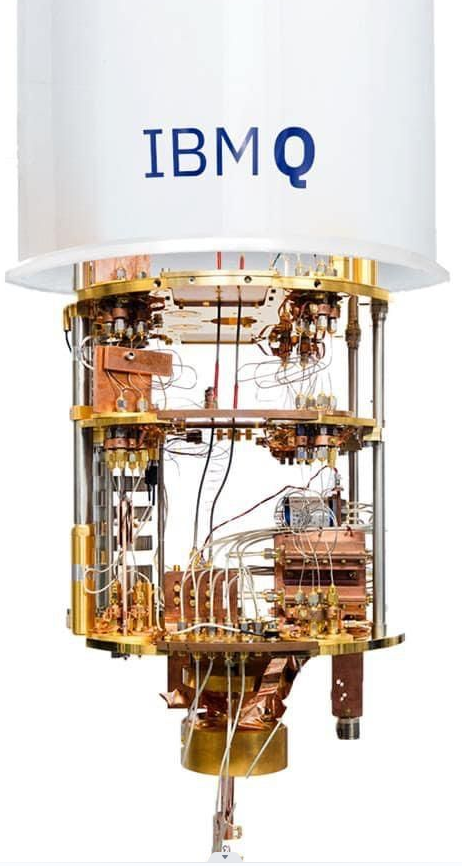
IBM’s Poughkeepsie site is a through-line in computing history—from the 701 mainframe era and System/360 to today’s IBM Quantum System Two datacenter. The location already hosts tiered-access quantum systems; IBM positions it as both the operational home for advantage-scale machines (targeted by end of 2026) and the build site for Starling.
What this could unlock
If IBM hits its milestones, expect meaningful progress in domains where circuit depth and logical reliability are decisive:
- Chemistry & materials: High-accuracy simulation (reaction pathways, catalysts, correlated materials).
- Optimization & logistics: Large-scale combinatorial problems where quantum circuits can prune or guide classical search.
- Finance & risk: Monte-Carlo-like workloads with structured quantum subroutines.
- Machine learning: Quantum kernels or subroutines that amplify specific structure in data.
IBM’s claim is that quantum advantage—clear wins in cost, speed, or efficiency over classical-only approaches—should start appearing by the end of 2026 on pre-FTQC platforms and then scale cleanly onto Starling-class machines.
Practical challenges (and how the plan addresses them)
- Overhead & scale: BB qLDPC aims to cut the physical-to-logical overhead dramatically versus surface codes, making hundreds of logical qubits more attainable.
- Connectivity: New c-couplers (on-chip) and ℓ-couplers (inter-module) bring the long-range interactions BB codes prefer into practical reach.
- Decoding latency: A hardware-class decoder design sidesteps the need for massive classical clusters, enabling real-time adaptivity.
- Universality overhead: Carefully engineered magic state factories and a compilation strategy tuned to the architecture reduce the non-Clifford tax.
- Modularity: Replaceable modules compartmentalize complexity, letting IBM scale systems incrementally instead of monolithically.
What’s the difference between physical and logical qubits?
Physical qubits are the raw hardware elements. Logical qubits are error-protected encodings spread across many physical qubits; they’re the abstraction you compute on in a fault-tolerant system.
FAQs
Why not just use error mitigation forever?
Mitigation helps on today’s devices, but doesn’t scale to arbitrarily deep circuits. Fault tolerance is how you run very long programs reliably.
What are BB (bivariate bicycle) codes?
A family of qLDPC codes designed to provide strong error protection with much lower qubit overhead than popular surface-code approaches at similar distances, enabled by sparse parity checks and tailored connectivity.
What is “magic state” distillation?
A standard method to realize non-Clifford gates (e.g., T) fault-tolerantly. You prepare noisy resource states, distill them to high fidelity, then inject them into your circuit to implement universal gates.
Do I have to wait until 2029 to start?
No. IBM’s pitch is to start building advantage-scale workflows now on Nighthawk-class systems and Qiskit Runtime, then port them to Starling as the hardware becomes fault-tolerant.
Key terms at a glance
- Fault tolerance: Running long quantum programs while actively correcting errors so results remain reliable.
- qLDPC codes: Quantum error-correcting codes with low-density parity checks—sparser, more hardware-friendly.
- Lattice surgery: A method for performing logical operations by merging/splitting encoded patches.
- Adapters (bridges): Circuits/couplers for moving logical information between modules.
- FPGAs/ASICs: Special-purpose classical hardware for ultra-low-latency decoding.
- Quantum advantage: A clear, practical win over classical-only approaches (cheaper, faster, or more efficient).
Internal linking suggestions (for your site)
- Link “quantum error correction” to your explainer on QEC and code distance.
- Link “qLDPC vs surface code” to a comparison piece on qubit overheads and thresholds.
- Link “magic state distillation” to your tutorial on non-Clifford gates.
- Link “Qiskit Runtime & dynamic circuits” to your developer guide for hybrid quantum-HPC workflows.
- Link “IBM Poughkeepsie history” to your feature on iconic computing milestones.
Bottom line
IBM’s blueprint for IBM Quantum Starling is not a single announcement—it’s a coherent, staged program: new couplers to enable BB codes; LPUs and adapters for logical compute and modular scale; magic state factories for universality; and a hardware-class decoder to keep the whole machine responsive in real time. If the company executes against this roadmap, fault-tolerant quantum computing—measured in hundreds of logical qubits and hundreds of millions of logical gates—moves from aspiration to engineered reality by 2029.