Scientists Are Racing to Grow Human Teeth in the Lab — A Breakthrough in Regenerative Dentistry
 MuhammadSalis
Researchers from King’s College London and beyond are developing lab-grown teeth using stem cells and advanced scaffolds. The breakthrough could revolutionize dentistry — making natural tooth regeneration a reality within a decade.
A Future Beyond Dental Implants
For millions who dread dental visits, the next generation of dentistry might not involve drills, crowns, or titanium screws — but regrown human teeth.
Across leading research centers in the UK, Japan, and the US, scientists are edging closer to one of regenerative medicine’s most ambitious goals: growing fully functional biological teeth in the lab.
At the forefront of this effort is Dr. Ana Angelova Volponi, director of regenerative dentistry at King’s College London, who has been studying how to coax living cells into forming teeth for nearly two decades.
“We are trying to recreate nature’s perfect design — a living tooth that can integrate, grow, and feel just like the original,” Volponi said.
A Breakthrough at King’s College London
In her latest research, published in collaboration with Imperial College London, Volponi and her team achieved a critical step toward human tooth regeneration: they successfully grew tooth-like organoids using a new hydrogel scaffold that better mimics the mouth’s natural environment.
In 2013, her group made headlines by growing a hybrid tooth from human gum cells and embryonic mouse “progenitor” cells. The experiment proved that adult human cells could participate in forming dental tissue — but the challenge was creating a structure strong and realistic enough for full development.
The new study solves part of that problem. Using hydrogel, a water-rich polymer that replicates the biological softness and fluid balance of gum tissue, the researchers enabled the cells to “talk” and form early tooth structures, known as tooth primordia.
Doctoral student Dr. Xuechen Zhang, a co-author of the study, explained:
“We gather the cells, spin them into a small pellet, and inject it into the hydrogel. After about eight days, we begin to see structures that resemble developing teeth.”
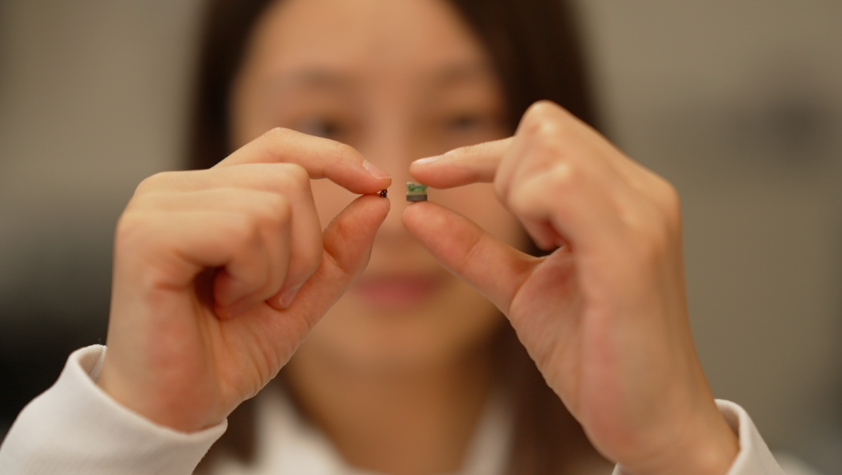
These organoids aren’t yet ready for implantation, but they mark a leap forward in understanding how to grow real teeth from human cells.
The Science Behind Growing a Tooth
Growing a tooth is like replaying evolution in miniature. It requires three essential components:
- Epithelial cells – forming the enamel-producing layer.
- Mesenchymal cells – forming dentin, pulp, and connective tissues.
- A suitable environment (or scaffold) where these cells can interact naturally.
In earlier experiments, researchers used collagen scaffolds, which couldn’t fully replicate the complex conditions of the human jaw. The hydrogel model changes that — allowing the developing cells to communicate and differentiate more effectively.
“It’s almost like a conversation between cells,” Volponi said. “The environment helps them know when to form enamel, dentin, and roots.”
From Lab Dish to the Dentist’s Chair
If scientists can replace the mouse progenitor cells with adult human stem cells, the next phase will involve growing a small “seed” tooth — one that could be implanted directly into a patient’s empty socket.
There are two possible clinical pathways:
- In-socket regeneration – Growing a tooth up to an early developmental stage, then implanting it into the jaw, where it can naturally mature.
- Fully grown implant – Cultivating a complete biological tooth in the lab before surgical placement.
Both methods aim to restore not just appearance, but function and feeling — something current dental implants cannot achieve.
The Advantages of Real Biological Teeth
A lab-grown biological tooth would be a living organ, complete with nerves, blood vessels, and periodontal ligaments. Unlike metal implants, it would:
- Fuse naturally with bone and gum tissue.
- Respond to pressure and temperature, preserving sensation.
- Avoid rejection or inflammation, since it would be grown from the patient’s own cells.
- Adapt over time, just like natural teeth.
“A true biological replacement would restore full oral function,” said Dr. Vitor C. M. Neves, a regenerative dentistry expert at the University of Sheffield. “This technology could eventually replace implants altogether.”
The Global Race to Regrow Teeth
King’s College London isn’t alone in this scientific sprint. Around the world, researchers are pursuing complementary paths toward the same goal: a future of tooth regeneration on demand.
Japan: Tooth Growth Drug Enters Clinical Trials
In Osaka, Dr. Katsu Takahashi and his team at Kitano Hospital are developing an antibody-based therapy that stimulates natural tooth growth. The treatment targets patients born with anodontia (a condition where teeth never develop). Human trials began in 2024, and researchers expect market approval by 2030.
United States: Regrowing Teeth Using Stem Cells
At Tufts University, Dr. Pamela Yelick’s group has successfully grown tooth-like structures in pigs, using a blend of human and pig cells. Because pigs regenerate teeth multiple times in their lifetime, they serve as an ideal model. The ultimate goal: trigger human jaw cells to grow new teeth without external cell sources.
At the University of Washington, Dr. Hannele Ruohola-Baker’s team is taking another route — growing dental pulp stem cells directly from human wisdom teeth.
“We’re uncovering the molecular blueprint of human tooth formation,” she said. “Our goal is to recreate that process entirely in the lab.”
The Challenges Ahead
Despite the optimism, significant hurdles remain before lab-grown teeth reach the clinic:
- Ethical and regulatory barriers for using stem cells.
- Scaling production for clinical-grade tissues.
- Ensuring durability and strength comparable to natural teeth.
- Timing and integration — ensuring that new teeth can attach to bone and gum correctly.
Still, experts are confident that these challenges are solvable within the next decade.
“Momentum in this field is accelerating,” said Ruohola-Baker. “Within 10 years, biological tooth repair or replacement could be a realistic dental option.”
The Promise of Regenerative Dentistry
Tooth regeneration sits at the intersection of stem cell biology, materials science, and bioengineering — a field now rapidly converging thanks to advancements in 3D printing, biomaterials, and gene editing.
The potential goes beyond replacing lost teeth. It could one day allow for:
- Regrowth of enamel and dentin to repair cavities naturally.
- Early intervention for gum and jawbone disease.
- Restoration of full dental function for patients with trauma or congenital disorders.
In the long run, growing teeth may even become a routine outpatient procedure, much like filling a cavity today.
A Revolution in the Making
For now, the hydrogel-grown “tooth seeds” at King’s College London remain under the microscope. But each new experiment brings the world closer to an era where lost teeth can truly grow back — cell by cell.
“It’s still early days,” Volponi said. “But if we can guide cells to form a living tooth, we can change the way dentistry — and healing itself — works.”
Internal Linking Suggestions:
Link to “What Are Organoids and How Are They Revolutionizing Medicine?”
Link to “Stem Cell Breakthroughs in Regenerative Medicine”
Link to “How 3D Bioprinting Is Transforming Organ Repair”
Link to “The Future of Dentistry: From Implants to Tissue Regeneration”
Link to “Japan’s Tooth-Growth Drug: A Step Toward Natural Regeneration”


1 thought on “Scientists Are Racing to Grow Human Teeth in the Lab — A Breakthrough in Regenerative Dentistry”